Now recruiting aged care pilot partners and testers
Training completion isn't capability. Help us prove what is.
Does your workforce have the capability to meet residents' mental health needs?
Mentapli is an AI-powered workforce capability platform helping aged care providers assess practical responses, identify gaps, support supervision and understand workforce capability.
Our working pilot prototype focuses on resident distress and aggression, depression, loss and grief. We're inviting aged care providers and frontline workers to help test and refine it.
Early-stage prototype. Assessment scores remain provisional and await clinical validation. Registering interest does not commit you to participating.
Your workforce completes training. But can they apply it when it matters?
Care workers regularly respond to resident distress, refusal of care, aggression, loneliness and grief.
Providers invest in onboarding, mandatory training and professional development. But training completion records rarely tell executives whether workers can demonstrate the judgement, communication, safe escalation and adaptability needed in real situations.
Mentapli aims to connect practical assessment, supervision evidence and organisational workforce intelligence.
Clinical risk
Can workers respond safely?
Training effectiveness
Can workers apply what they learn?
Workforce capacity
Are existing skills fully utilised?
Does our workforce have the capability required for the people we care for — and how do we know?
Help solve a real care challenge — without adding another training program
We're inviting aged care organisations and frontline workers to help develop a more effective way to understand mental health capability in everyday care.
For aged care organisations
Shape a solution around the operational challenges you already face.
As a founding pilot partner, your organisation can:
- Prioritise the care situations and workforce challenges we assess.
- Help shape realistic scenarios and useful workforce reporting.
- Explore how assessments could fit existing onboarding, coaching and supervision.
- Receive relevant pilot findings and learning.
- Influence how Mentapli could support workforce quality, clinical governance and future care delivery.
We recognise that staff time is valuable.
We'll agree the required staff time, management involvement, reporting access and follow-up activities before participation. Our aim is to minimise roster disruption and use existing staff development time where feasible.
The first session takes about 25 to 30 minutes. A full pilot involves a few short sessions over several weeks.
For frontline workers
Your experience matters. Help us build a tool that reflects real care.
We're inviting personal care workers, assistants in nursing, lifestyle workers and trainees to test realistic care scenarios and provide feedback.
You'll help us understand whether the experience is relevant, accessible and fair across different backgrounds, levels of experience and language preferences.
This is product research and testing — not an employment or pay assessment.
Know what your workforce can do — not just what training they've completed
Mentapli is an enterprise workforce capability assessment and intelligence platform. We're building a continuous approach to identifying, developing and demonstrating practical mental health capabilities.
Mentapli is built around the APLI method
Assess demonstrated capability
Pinpoint gaps and priorities
Lift targeted development
Inform verified progress and guide decisions
See the enterprise dashboard
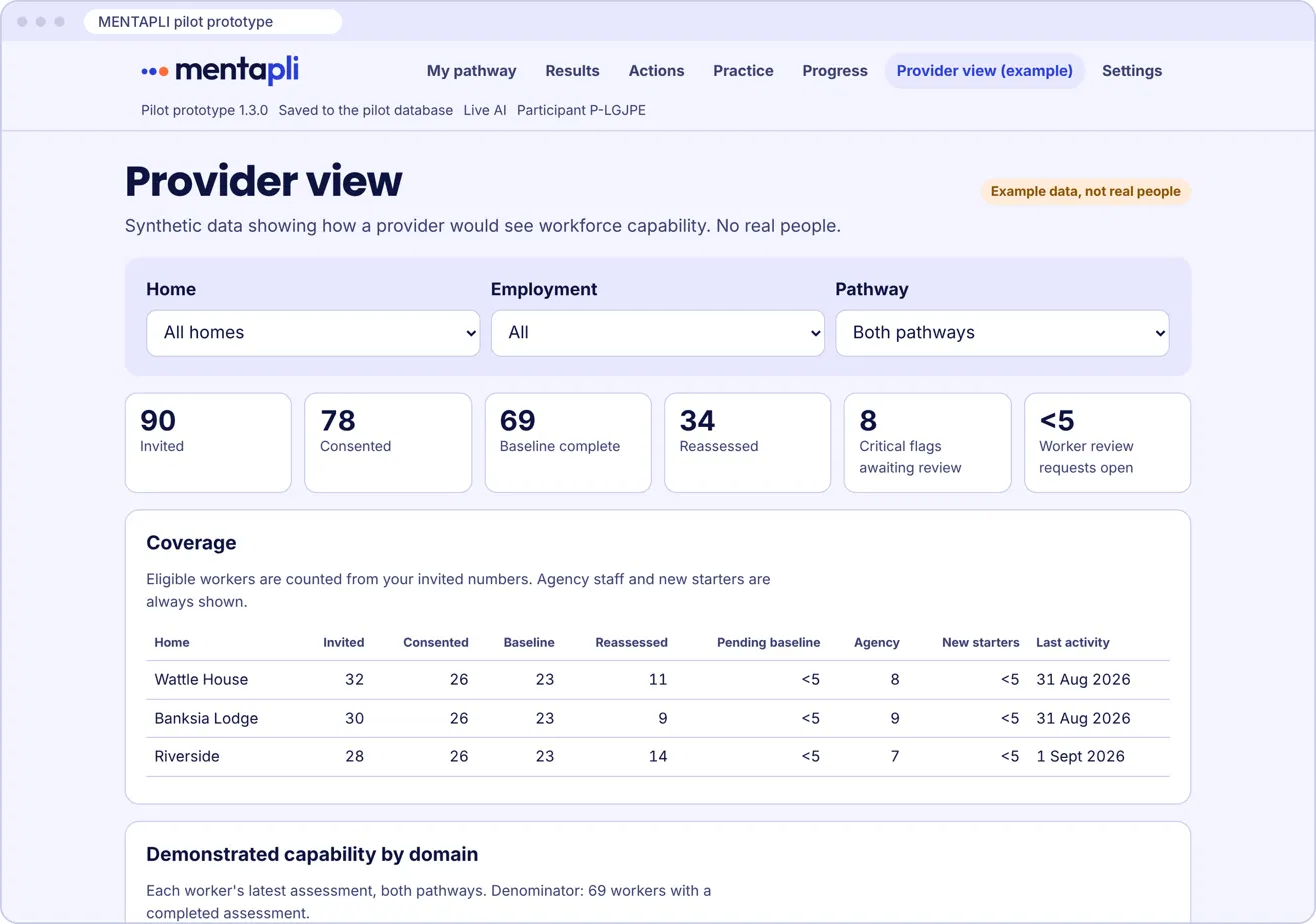
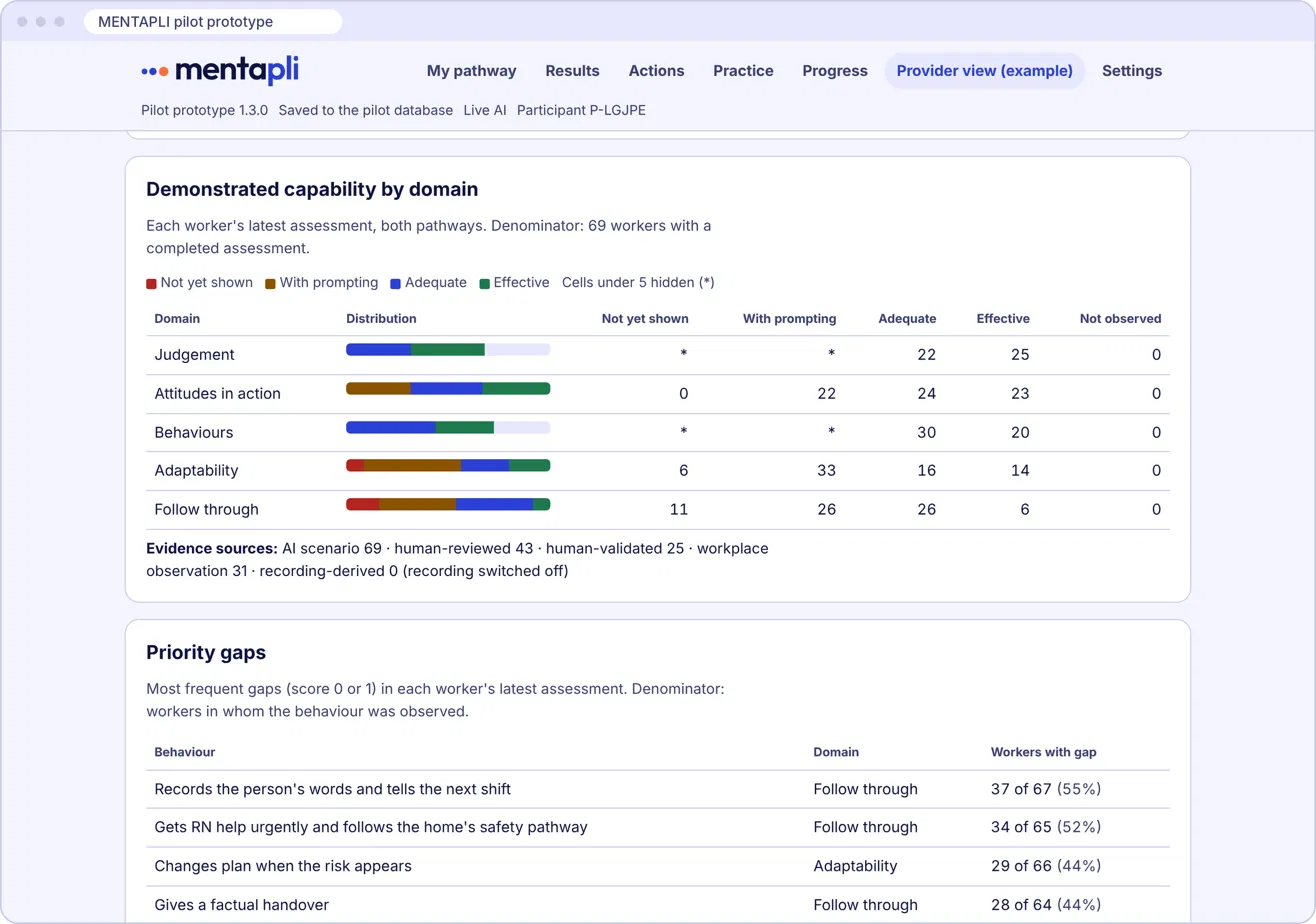
An aggregated provider dashboard shows workforce participation, capability coverage, development priorities, provisional results, supervision activity and reassessment progress.
 (opens full size in a new tab)
 (opens full size in a new tab)
Screenshots from the working prototype (version 1.3.0), showing synthetic example data, not real people. Tap or click an image to see it full size.
The goal: measurable workforce capability and intelligence that helps organisations make better development decisions.
Formal credentials, externally validated scoring and independent proof of improved resident outcomes are not yet available.
Try a realistic care conversation
Mentapli's working prototype currently includes two assessment pathways.
Responding to resident distress and aggression
A resident refuses personal care. As the situation develops, a possible physical cause of distress emerges.
How does the worker respond, adapt and escalate appropriately?
Responding to grief and low mood
A resident experiencing bereavement becomes withdrawn and expresses a concerning statement about their safety.
Can the worker recognise the risk, respond empathetically and seek appropriate support?
Each assessment uses a fictional AI resident, a change in circumstances, worker reasoning and a structured written handover.
Example scenario: distress and aggression
You're supporting Mr T, a resident. He's usually calm, but today he is pacing and speaking loudly. He says someone has moved his things, steps toward you and shouts: “You people are always stealing from me!”
What do you do first?
Choose an option to see the feedback a worker would get.
This is an illustration made up for this page, not one of the prototype's assessments and not evidence of real worker outcomes. It involves no real person.
The public demonstration uses fictional and synthetic example information. The controlled pilot operates separately with invited participants.
Built for real care. Now being tested with the people who deliver and receive it.
Our working prototype connects simulated assessments, trainer review, coaching, workplace observations, reassessment and organisational capability reporting. We're now focused on validating five areas.
Clinical relevance
Are scenarios, safety-critical behaviours, escalation requirements and proposed scoring methods appropriate?
Assessment reliability
Do AI-generated assessments and evidence consistently align with trained human reviewers?
Fairness and accessibility
Are assessments useful and fair across different roles, languages, literacy levels and levels of English proficiency?
Practical implementation
Can assessment and supervision fit into busy care environments without creating unreasonable additional workload?
Evidence of improvement
Can reassessment and workplace observations demonstrate meaningful changes in practical capability?
We're seeking aged care providers, workers, clinical specialists and older people to help us answer these questions.
Designed to support workforce capability relevant to the strengthened Aged Care Quality Standards
The strengthened Aged Care Quality Standards place expectations on aged care providers around worker competence, supervision, safe care, person-centred practice and continuous improvement.
Mentapli is being developed to help providers generate additional evidence of how workers demonstrate practical capabilities relevant to these requirements. Our working prototype explores how workers respond to mental health needs, changed behaviour, clinical safety concerns and everyday care situations.
Mentapli complements existing workforce development, training and clinical governance systems. It does not independently establish regulatory compliance.
What we're still working on
We're continuing to develop and validate the platform, including clinical review, involvement of older people, broader cultural and safety competencies, and links to existing provider quality and incident management systems.
See the detailed alignment
| Aged Care Standards area | How Mentapli 1.3.0 contributes | Current status |
|---|---|---|
| 2.9 Human resource management | Assessments, trainer validation, coaching, reassessment and workplace evidence | Supports aspects; not a full training and competency management system |
| 5.5 Mental health and wellbeing | Scenarios explore grief, low mood, distress and safety escalation | Supports selected behaviours |
| 5.6 Cognitive impairment | Assessments explore refusal of care, changed behaviour and unmet needs | Supports selected behaviours |
| 3.2 / 3.3 Safe care and communication | Assessment of escalation to registered nurses and structured handover | Supports selected competencies |
| 1.1–1.3 Person-centred care | Assesses dignity, choice, privacy and respectful responses to refusal | Supports selected behaviours |
| 2.8 Workforce planning | Maps aggregate workforce capabilities and development priorities | Partial; no rostering or deployment integration |
| 2.4 Risk management | Identifies capability-related concerns and potential safety gaps | Partial; no integration with risk registers |
| 2.5 Incident management | Flags potential unsafe responses | Not yet; no incident management integration |
| 2.1 Partnering with individuals | Plans to incorporate older people's experience into design | Not yet; co-design not completed |
Outstanding requirements (work in progress)
- Clinical validation of assessment criteria and scoring.
- Broader assessment coverage of culturally safe and trauma-aware care.
- Additional competencies covering medical emergencies, the Aged Care Code of Conduct and the Serious Incident Response Scheme.
- Direct involvement of older people and families in assessment design.
- Integration with provider incident and risk management systems.
- Broader organisational quality and governance reporting.
- Evidence connecting assessment results with observed practice and care outcomes.
Better assessments begin with the people receiving care
Older people and their supporters should help shape what safe, respectful and person-centred responses look like in everyday care.
Our initial scenarios draw on research and care practice. However, direct co-design with older people and their families has not yet been completed.
We're seeking older people, family members and consumer advocates to help us review:
- Whether our scenarios reflect realistic care experiences.
- What respectful communication and person-centred care look like.
- How workers should respond to distress, refusal of care, grief and loneliness.
- How dignity, independence, cultural identity and personal preferences can be better reflected.
- What meaningful improvements in care would look and feel like.
We want to develop Mentapli with the people receiving care, not simply for them.
AI-supported assessment. Human-reviewed decisions.
Mentapli is designed to support professional judgement, not replace it. In our working prototype:
- AI simulates fictional residents and identifies evidence of observed worker behaviours.
- Defined scoring rules calculate provisional assessment results.
- Trainers review assessment evidence and can amend proposed scores.
- Safety concerns and red flags require human review.
- Workers can see their own information, provide context, request a review and withdraw.
- Providers receive aggregated information rather than individual assessment records.
- Small groups are suppressed in current provider reporting to support privacy.
The prototype does not make employment, pay, disciplinary, formal credentialling or clinical treatment decisions.
Live workplace recording is currently disabled.
Clinical sign-off, AI reliability testing, language fairness and privacy impact assessment remain outstanding prior to broader deployment.
We believe credible assessment requires transparent scoring, appropriate safeguards and human oversight.
I'm Inga, and I'm building Mentapli.
I've spent more than 15 years building and scaling health and mental health solutions, including leadership roles at Bupa and the Black Dog Institute.
My experience spans workforce education, digital health, research translation, commercialisation and large-scale business transformation.
This mission is also deeply personal.
My uncle lived with significant mental health challenges, and later in life his needs were often misunderstood within traditional care settings.
His experience shaped my belief that the future of mental health care must move beyond awareness and education towards developing and demonstrating the capabilities of the workforce we already have.
That's why I'm building Mentapli.
Questions, answered
Is there a cost?
No. Taking part in the early research and pilots is free for care workers and providers. If we later offer a paid product, you'll have a clear choice and no obligation.
How long does it take?
The first session takes about 25 to 30 minutes. A full pilot involves a few short sessions over several weeks. We agree the time involved with you before you commit.
Do I need technical experience?
No. If you can use a phone, tablet or computer, you can take part. We'll show you how in the first session.
Can I withdraw?
Yes, at any time and for any reason. You can also ask us to delete what you've shared.
Will my employer see my results?
If you register as an individual, your employer isn't involved and doesn't see anything. In a provider pilot, providers receive aggregated information rather than individual assessment records.
Do participants need to involve residents?
No. All scenarios are made up, and no residents or clients take part. Please don't share real resident or client information with us.
Is this a clinical assessment?
No. We're focused on practical workforce capability within each worker's role and scope. It doesn't diagnose anyone or replace clinical judgement. Scores are provisional and clinical validation is still required.
How is this different from training?
Training usually records that someone completed a course. Mentapli is not a training provider. We're developing ways to see what a worker can actually do, so existing training and coaching can focus on what they need.
Help us shape Mentapli
Choose the option that fits you. It takes about a minute. Registering doesn't commit you to anything.
- 1RegisterTell us a little about you or your organisation using the form below.
- 2Talk and consentWe contact you, explain what's involved and ask for your consent. Nothing starts without it.
- 3Take partTry scenarios and share feedback. We use what we learn to develop the tool.
- 4See what we learnedWe share what we found and what we're changing, and you decide whether to continue.
Unlock the mental health workforce we already have.
Today, millions of frontline workers encounter mental health needs without consistent ways to assess, develop and demonstrate practical capability.
Our ambition is to make Mentapli a global workforce capability intelligence platform. We're starting in residential aged care, with future opportunities across home care, disability, community services and healthcare.
Over time, we want to support recognised capability records, portable capability passports and a stepped-care workforce. This could enable appropriately assessed, trained and supervised frontline workers to deliver additional clinically appropriate mental health support within their scope, while specialist clinicians focus on more complex needs.
More capable workers. Better use of specialist clinicians. Safer care. Greater access to mental health support.
Formal credentials, capability passports and stepped-care intervention pathways are future ambitions and are not part of the current working prototype.